Updated August 2026
Starting a soap business: curing, lye safety, and labeling
Soap is one of the most ordinary craft businesses to run and one of the more closely regulated products to sell. The business half is the same as any other: you cost a bar, price it above cost, sell it online and at markets, and keep records so you can make the same bar twice. The product half brings three things almost nothing else in this playbook carries — a category line you cross by what you write on the label, weeks of curing between making and selling, and a caustic material that has to be handled properly.
This chapter costs those three honestly and points at the authorities for the rest. It is informational only: you file with the FDA yourself, nothing here assesses your product, and none of it is legal advice.
The method underneath is unchanged from pricing handmade products: materials, plus labor at a real rate, plus a share of overhead, into a true cost per unit, with your price above it at a margin you choose. If that math is new, the guide on pricing handmade products without underpricing yourself argues it on a single object before any soap is involved.
What a bar actually costs
Start from a cost per gram for every oil, butter, additive, fragrance, and the lye itself: pack price divided by pack weight, off your current invoice rather than a remembered one. A soap recipe is proportional in the same way a bread formula is, so once each input carries a per-gram cost, a batch cost scales to any size without re-deriving anything. Oils arrive by the pound or the pail and leave as bars, which is a conversion worth keeping straight — the unit conversions article covers how those are handled once the numbers stop living on paper.
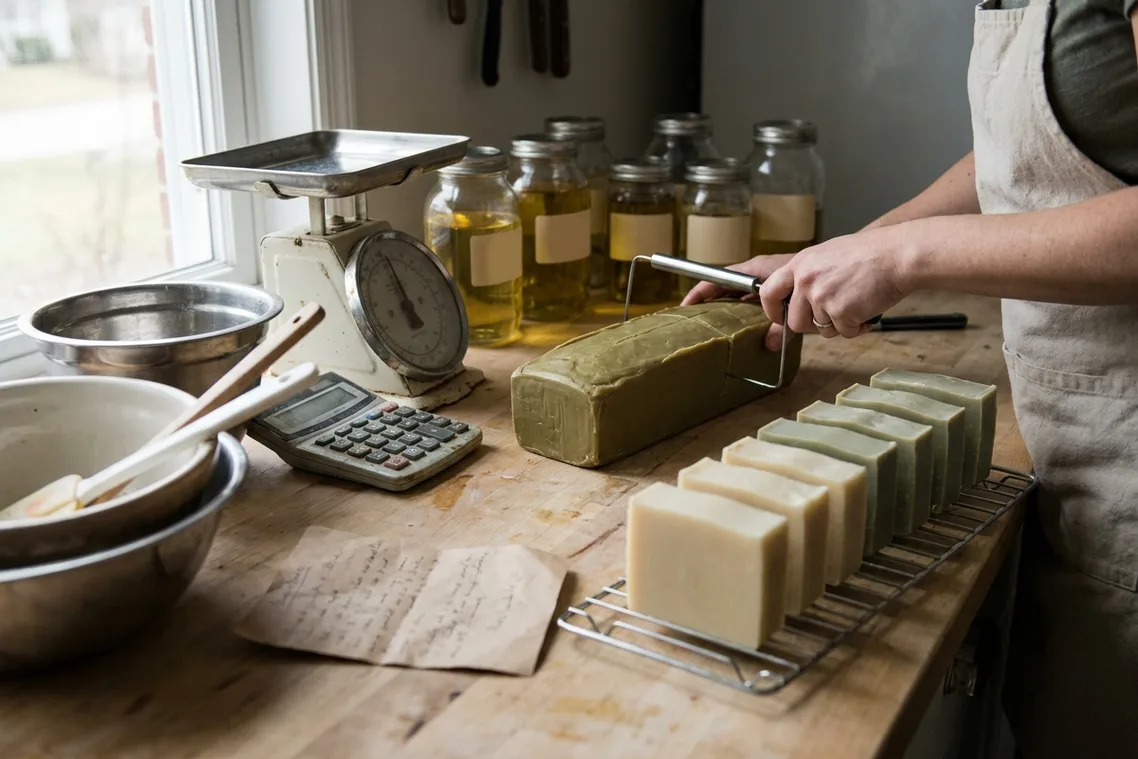
Then divide by bars you can sell, not bars the mold theoretically holds. Between the pour and the shelf you lose the end pieces of a loaf, the crooked cut, the bar with enough soda ash or a bad partial gel to be a second, and the slices you keep back as testers. Testers are a real cost even though they never earn anything: count them first, then decide to give them away.
Packaging is the line new soap makers underestimate, because it scales one for one with units. A wrap, a label, a box or a band, and a shipping mailer all belong in the per-bar cost. If you also make butters, balms, scrubs, or anything else that leaves in a jar, the small-batch cosmetics costing page assembles that whole stack on one product, so you can see where the packaging lands before it surprises you.
Keep the equipment you buy once — molds, a cutter, a stick blender, a scale, safety gear — separate from the materials you consume every batch. The startup costs chapter and its calculator total your cash-to-launch, and that durable-versus-consumable split is the distinction it asks you to get right.
Curing changes both your weight and your timing
Cold-process soap needs weeks in the open air before it is ready to sell, and two separate things happen in that window.
The first is weight. A bar loses water as it cures, so it leaves the mold heavier than it will be when a customer buys it. If you print a net weight on the wrapper, that number has to be true at the point of sale rather than at the point of cut. Measure your own loss instead of borrowing a figure: weigh a bar the day you cut it, weigh the same bar the day you would put it on a table, and the difference over the starting weight is your cure loss for that recipe in your space. It varies with the formula, the humidity, and how long you actually cure, which is exactly why somebody else’s number is no use to you. Scale your bars so the finished weight lands where the label says it does.
The second is cash. A batch you pour today is money and shelf space committed for weeks before it can earn anything, and that is a lead time most crafts do not carry: a potter can sell a mug the week it comes out of the glaze fire, and an engraving shop can cut a sign the morning it is ordered. Soap cannot be hurried, and there is no version of the process where a rush order changes that.
So plan production around the cure window rather than around demand. Soap for a market next month has to be poured well ahead of it, and a shop that reorders on a Tuesday cannot be filled that week from an empty rack. Build the cure into the schedule the way a baker builds in proofing: it is not dead time, but it is committed time. Knowing how much of your inventory is sitting in cure — owned, counted, and not yet sellable — is what keeps you from over-pouring in a quiet month and under-pouring before a busy one.
Is your soap a “true soap” or a cosmetic?
This is the first real fork, and it decides which rules you live under. It comes down to composition and claims.
“True soap” has a narrow definition: the cleaning comes from an alkali salt of fatty acids, and you sell it purely as soap. When your product meets that and promises nothing more, it is regulated by the Consumer Product Safety Commission, not as an FDA cosmetic (per the FDA “Small Businesses & Homemade Cosmetics” fact sheet and CPSC soap guidance).
Step outside that lane and the category changes:
- Add a moisturizing or scent claim, or add cosmetic ingredients, and it becomes a cosmetic under FDA rules.
- Claim it treats a skin condition, and it becomes a drug, a much heavier category (per the FDA “Small Businesses & Homemade Cosmetics” fact sheet and CPSC soap guidance).
The bar that leaves your kitchen can be chemically identical in all three cases. The claim on the label is what moves it between categories. The labeling and regulations chapter covers this line in full; the point to internalize here is that you choose your lane every time you write a label or a product description.
What MoCRA asks if your soap is a cosmetic
If your soap is a cosmetic, because of its claims or ingredients, the governing law is MoCRA, the Modernization of Cosmetics Regulation Act of 2022.
MoCRA carries a small-business exemption. If your average annual U.S. cosmetic sales over the prior three years are under $1 million, you are a small business exempt from facility registration, product listing, and good-manufacturing-practice rules (per the FDA and Obelis, 2024). Many soap makers working from home fall under that line.
The exemption does not free you from safety and records, though. Even as an exempt small maker, you are still expected to:
- Keep safety substantiation for each product.
- Keep adverse-event records, generally for three years, with a serious adverse event reported by the responsible person within 15 days.
- Meet labeling rules, including a contact channel on the label for adverse-event reports, in effect since December 2024 (per Cosmeservice and the FDA).
None of that is something a tool files on your behalf. You are the responsible person; you keep the records and you make any reports. What your systems can do is make the records easy to hold, which is the whole reason batch records stop being optional for soap.
Lye demands real safety precautions
Working with lye (sodium hydroxide) is the part of soap making that deserves genuine respect, and it has no equivalent in most of the crafts this playbook covers. Lye is caustic. Handling it calls for real precautions: eye protection, gloves, good ventilation, careful measuring, and following a trusted, tested process rather than improvising. Treat it as the serious material it is, learn the handling rules from a reputable soap-making source before your first batch, and never cut corners because a batch is running late. This chapter cannot teach lye safety in a paragraph, and it should not. Go to a dedicated soap-making safety resource and learn it properly.
Batch records are not optional for soap
Across the rest of this playbook, batch records are strongly recommended. For soap sold as a cosmetic, keeping records is part of what is expected of you.
A batch record — recipe, materials, lots, yield, and dates — is the backbone of the safety substantiation and adverse-event trail described above (per the FDA and Cosmeservice). It is also what lets you reproduce a good bar and trace a bad one back to a specific material or lot. The batch records chapter and the free batch-record sheet apply directly to soap; soap just removes the “optional” from the habit. Start the sheet with your first batch; reconstructing records after the fact is far harder, and for cosmetics it is a gap you do not want.
Measuring your own numbers
One log does double duty here, which is the happy part of soap’s paperwork: the record the rules ask for is the same record your costing needs.
For each batch, write down the date poured, the recipe, the lot on every oil and every fragrance, the lye lot, the total batch weight, the bars cut, the bars that came out sellable, the losses with a cause, the cut weight of a sample bar, the date it comes out of cure, and its weight that day. Then re-cost your oils from current invoices on a schedule, the way the supplies and sourcing chapter describes, because oil and butter prices move.
Six months of that replaces every estimate above with your own figures: a real cost per sellable bar, a real cure loss, a real yield per mold, and a real cure window for each recipe. Those four are the whole soap cost model, and they are yours rather than an average of somebody else’s kitchen. They are also what a cost of goods sold is built from at the end of the year, which COGS for makers explains in plain English.
What carries straight across
Once curing and the category line are handled, soap is the same business the rest of this playbook describes. Where to sell applies unchanged, and soap wholesales unusually well, so the margin math in craft fairs and wholesale is the section to read before a first stockist conversation — remembering that a stockist reorder has to be poured a cure ahead of the order. Bars are heavy for their price, so shipping and mailers belong in your cost rather than in a shrug at the end of a sale. And the same costing spine runs under every craft here, whether you pour candles, throw pots, or bake.
Confirm the rules for your own soap
Soap regulation turns on your specific formulation and the exact claims you make, and requirements change over time and vary by where you sell. Treat this chapter as a map to the right authorities, not a verdict on your product:
- For true soap: the Consumer Product Safety Commission.
- For soap sold as a cosmetic: the FDA cosmetics pages and its “Small Businesses & Homemade Cosmetics” fact sheet.
Before you rely on any of this for your own products and claims, confirm the current requirements directly with the agency, or with a professional. Nothing here is legal advice. Get the cure loss, the sellable yield, and the category line honest, and the last regulatory step is always yours.
Frequently Asked Questions
- What is different about running a soap business?
- Three things, and none of them is the business itself: you still cost your units, price above cost, sell online and at fairs, and keep batch records, so the spine chapters apply directly. What is particular to soap is that it can be a consumer product or an FDA cosmetic depending on the claims you make, that cold-process soap needs weeks of curing you have to plan inventory and cash around, and that working with lye demands real safety precautions on every single batch.
- Is my soap a "true soap" or a cosmetic?
- It comes down to composition and claims. "True soap", where the cleaning comes from an alkali salt of fatty acids and you sell it purely as soap, is regulated by the Consumer Product Safety Commission, not as an FDA cosmetic. Add moisturizing or scent claims, or cosmetic ingredients, and it becomes a cosmetic under FDA rules; a claim to treat a skin condition makes it a drug (per the FDA homemade-cosmetics fact sheet and CPSC soap guidance). The labeling chapter covers the line in detail.
- What records does a soap maker need to keep?
- If your soap is a cosmetic, you are expected to keep safety substantiation and adverse-event records even as an exempt small business (per the FDA and Cosmeservice). A batch record — recipe, materials, lots, yield, and dates — is the backbone of that, plus it lets you reproduce a good bar and trace a bad one. The batch-records chapter and the free batch-record sheet apply directly; soap just makes them non-optional.
- Does the pricing calculator work for soap?
- Yes. Soap fits the costing method directly: materials (oils, lye, additives, packaging) plus your labor plus overhead, so the pricing calculator on the pricing chapter works without changes. The one wrinkle is curing time, which is a cash-flow fact rather than a costing one: cold-process soap ties up money and shelf space for weeks before it can sell, so plan your batches and your inventory around that lead time.
Know your real cost per unit without the spreadsheet
Batchnook is built for solo and small-crew makers — snap a photo of a supplier receipt, approve the lines it read, and every product's true cost and margin recomputes. The free tier tracks your first 3 products with no card and no countdown, enough to prove the math on your bestsellers.
Get this as a 7-day course
One short email a day, the whole start-to-first-job path, written for someone doing this for the first time. Unsubscribe with one tap, any time.
You're in. Day one lands within a day. Check the promotions tab if it hides.
That didn't send. Check the address and try once more.