Updated August 2026
How to start a handmade business (2026): the complete playbook
You can start a handmade business this month, whatever you make. The craft is learnable, the market is real, and none of it requires permission. What separates the makers who build something durable from the ones who quietly fold after a slow season is not talent at the bench. It is whether they treated it as a business from day one: knowing their real costs, pricing above them, meeting whatever safety and labeling duties their craft carries, and keeping records well enough to make the same good thing twice.
This playbook is the whole arc, in order. The ten spine chapters are the same for every trade, because costs, pricing, where to sell, batch records, photography, fairs, and the business footwork are one craft business under the hood. Seven craft chapters carry that method into each trade’s own math, which is where they diverge: a kiln bills by the load, an oven by the bake, a printer by the hour, and a sheet of plywood by how much of it you get to sell.
It is built to be useful whether or not you ever sign up for anything. Two of the tools here — a pricing calculator and a break-even calculator — are free to use on the page, and there is a batch-record sheet you can take with you. Start with your craft, then work the spine in order.
Start with your craft. The ten spine chapters below are the same for every trade. These seven are where the math stops being the same.
- CandlesCheap materials, a real safety duty. The wax, wick, vessel, and fragrance are one decision rather than four, and burn testing comes before the first sale.Start here →Candle safety & testing →
- Soap & bath-and-bodyCure time is a lead time you plan inventory around, lye is handled with real care, and the claims you make decide whether you are selling soap or a cosmetic.Start here →
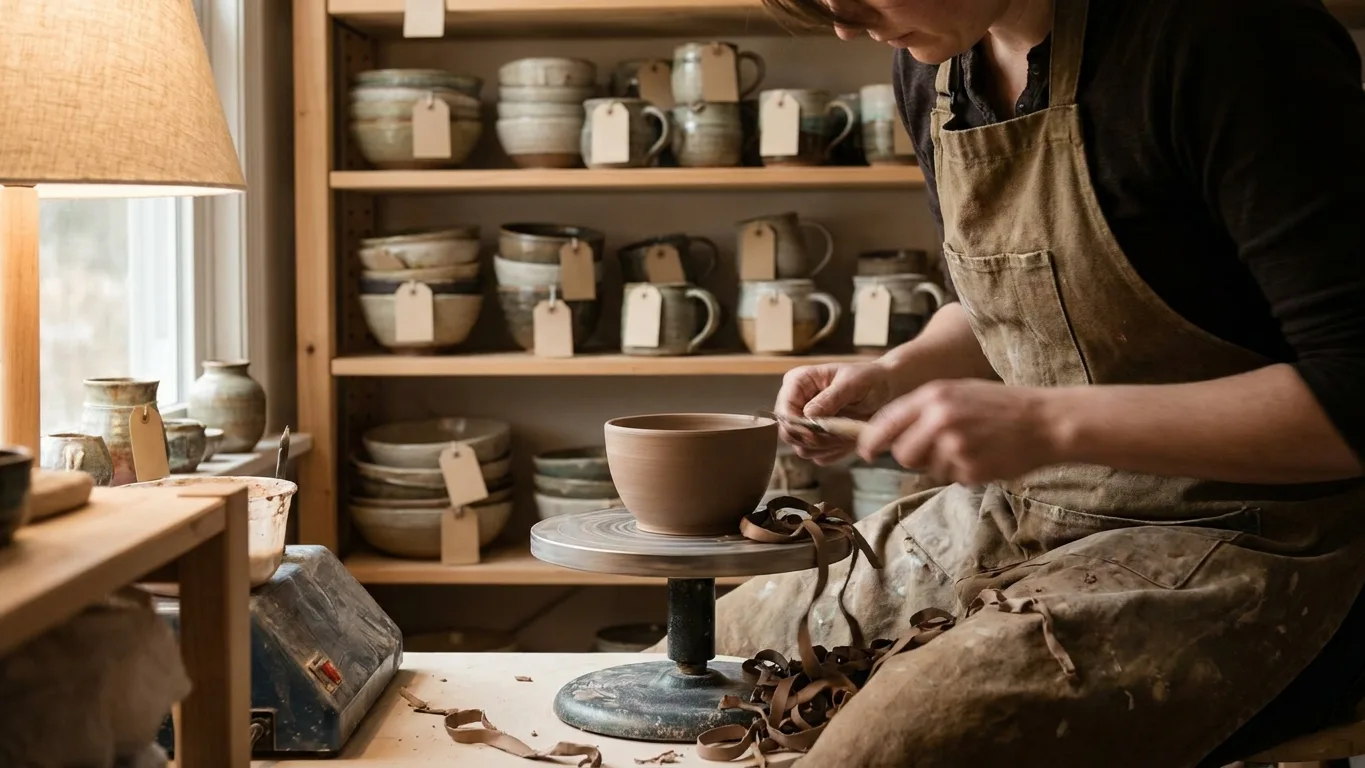
- Ceramics & potteryYour dominant cost is charged per kiln load, not per piece, most work is fired at least twice, and the denominator is the pieces that survive to sale.Start here →
- JewelryStartup spend leans toward durable tools, the metal price moves under you between batches, and heavy-metal limits reach further than most makers expect.Start here →
- Baked goodsDough loses weight in the oven, the oven bills you by the load, and anything unsold inside its shelf life is a total loss — so sell-through is a cost, not a sales figure.Start here →
- 3D printingThe grams your slicer reports are not your material cost, machine hours are the real material, and a failed plate costs whatever it had already spent.Start here →
- Laser & CNCNothing is bought in the unit it sells in: material comes by the sheet, tooling wears by the minute, and setup makes quantity change the unit cost.Start here →
What it really costs to start
The first question everyone asks is the cost, and the honest answer depends far more on what you make than on how ambitious you are.
Every craft splits its spending the same two ways: one-time purchases, and the materials you consume every single batch. What changes between trades is the ratio, and it inverts completely. A candle or soap maker buys a scale and a pot once and then spends on materials forever. A ceramicist, a printer, or a laser shop buys the machine before selling anything, and then spends comparatively little per piece. Both ends have their own failure: the consumables-led maker underprices the recurring materials, and the machine-led maker costs a unit at the price of the plastic and never charges for the machine hours.
The one figure with a well-documented median is candles, where the median business startup runs around $1,000 and a home-based operation typically spans about $800–$6,000 depending on ambition (per Starter Story and CandleBusinessPro, 2025). A tool-led craft opens higher: a home or online-first jewelry business commonly starts around $2,000–$5,500, with tools often the largest early share (per Starter Story, 2025). There is no honest single number covering all seven.
What it costs to start a handmade business breaks every line item into two budgets you can total for your own cash-to-launch, with a per-craft list of what the one-time spend actually is. Start there to replace the guess with a number.
Pricing that actually holds
This is the single most important habit in the playbook, because every other decision — which channel to sell on, whether wholesale makes sense, what to scale — depends on knowing your real cost per unit.
Price from your cost, not from what a competitor charges. Add up the materials consumed in one unit, your own labor at a real hourly rate, and a share of your overhead into a true cost per unit, then set a price above it at a margin you choose. Pricing handmade products walks the method, and the pricing calculator on that page does the math once you supply your numbers.
The part that varies by craft is how you build the materials figure, and it varies more than most makers expect. Firings, oven loads, machine hours, and sheet yield each hide the real cost somewhere a different trade would never think to look. Your craft chapter covers your version.
Where to sell
A great product nobody sees does not pay rent. The main channels each solve a different problem, and most established makers eventually run more than one:
- Marketplaces bring their own shoppers and are fast to open, but you pay fees and compete inside a crowded search.
- Your own store gives you control of the brand, the customer relationship, and the data. You drive all the traffic yourself.
- Craft fairs give you same-day cash, direct feedback, and email signups you own, at the cost of a booth fee and your whole day.
- Wholesale trades margin for volume and reach, putting you on shelves you would never reach alone.
The catch that ties them together: every channel takes a cut, and that cut is a cost you have to price for. A price that works at a fair can lose money on a marketplace once fees land. Where to sell your handmade products compares them factually and shows how each channel’s fees change your pricing.
Safety and the rules that reach your craft
Every craft here carries some real duty before the first sale, and they are not the same duty.
A candle is an open flame in someone’s home, so burn testing comes first. Soap and cosmetics turn on the claims you make and the records you keep. Tableware has to be safe to eat off. Food carries allergen, date, and cottage-food obligations that vary by state. Jewelry, and anything aimed at children, runs into heavy-metal limits. A machined or printed object inherits whatever regime its use puts it in.
Labeling and regulations for handmade goods maps which lane your product is in and points you at the primary source for it. It is written to inform and to route you to the right authority, never to give legal advice. Treat it as a map, and confirm the current rules for wherever you sell.
Supplies, sourcing, and buying the right amount
Where and how you buy shapes your margin more than most makers realize.
The discipline that matters is buying small to test before you commit. Nearly every craft has a set of materials that only work as a combination — wax with wick and vessel, clay body with glaze and firing cone, filament with nozzle and profile, sheet stock with the settings you cut it at. Prove one combination in small quantities, then buy bulk only for the combinations your sales actually support. Overbuying “to save money” is one of the most common ways new makers lock up cash they need.
Supplies and sourcing for a handmade business covers the material categories every trade splits into, when bulk pays, and why tracking your lots and vendors saves you badly if a material ever has a problem.
Batch records: making the same product twice
If there is one habit that quietly separates a hobby from a business, it is this one. A batch record is a short, dated log of how you made one batch: the recipe and version, the exact materials and quantities, the vendor and lot for each, your craft’s key ratio, the number that survived to sellable, and how it turned out.
That record does three jobs at once. It lets you reproduce a winner on purpose instead of by luck. It lets you trace a problem back to a specific material. And for soap, cosmetics, and food work, it is part of the records you are expected to keep. It is also where your true cost per unit comes from: the same number the pricing calculator needs. Batch records and making the same product twice shows the light version that works, and you can take the free batch-record sheet from this page to start from batch one. Reconstructing records later is far harder than keeping them from the start.
Selling in person and to shops
When you are ready to sell off the internet, in-person selling is where a lot of businesses find their footing. But a booth is a bet, and you should know your break-even before you pay for it. Add up the booth fee, travel, and your time, divide by your profit per unit, and you know how many units you have to move to come out ahead.
Craft fairs and wholesale has a break-even calculator to judge a show before you commit, a packing checklist so nothing gets left home, and the method for stepping into wholesale without giving away your margin — because wholesale only works if your costs leave room at roughly half your retail price, and if you can make the identical product on every reorder.
Photography that sells
Online, your photo is the product. A shopper cannot hold what you made or smell it; they judge all of it from an image. The good news is you do not need a studio or an expensive camera: a recent phone in good window light shoots listing-quality photos, because light matters far more than gear.
Product photography basics covers shooting with window light and a phone, simple backgrounds and styling, the specific shots every listing needs — including what each craft in particular has to show — and a consistent editing recipe so your whole shop reads as one brand instead of a pile of snapshots.
The business footwork
Somewhere in your first months you have to handle the unglamorous setup: how you are structured, your tax numbers, and whether you are insured. Many makers form an LLC for the liability separation between the business and their personal assets; filing fees run about $35 to $500, most between $50 and $200 (per LLC University, 2025–2026). An EIN is free directly from the IRS. Most localities also want a business license and sales-tax registration, and many venues require proof of product-liability insurance before they will let you sell.
Taxes, LLC, and insurance walks the footwork with real cost ranges and a clear line: it is informational, not legal advice, and a short talk with a local professional pays for itself.
Growing when the time comes
Eventually you may sell out consistently and start wondering whether to grow. Growth is not automatically good. Done ahead of demand, it just ties up cash. Done at the right time, in the parts of the business that actually earn, it turns a busy hobby into one that pays. Scaling a handmade business past the kitchen table covers when to grow, how to reinvest in the products with real margin, how to bulk safely, and how to systemize your records before volume breaks them.
Your craft’s own math
The spine above is the same for everyone. These seven chapters are where it stops being the same, and each one teaches you to measure your own numbers rather than handing you somebody else’s — costs vary too much between studios for a borrowed figure to be worth anything.
- Candles. Cheap materials against a real retail price, a wax-wick-vessel-fragrance combination that is one decision rather than four, and burn testing before the first sale. How to start a candle business is the arc, and candle safety and burn testing is the routine.
- Soap and bath-and-body. Cure time is a lead time you plan inventory and cash around, lye demands real care every batch, and your claims decide whether you are selling soap or a cosmetic. Starting a soap business covers all of it, and the small-batch cosmetics costing page shows what a jar of body butter costs once the butters, oils, and packaging are counted.
- Ceramics and pottery. Your dominant cost is charged per kiln load rather than per piece, most work is fired at least twice, and the denominator is the pieces that survive to sale. Pricing pottery and ceramics works all three out from your own firings, and the ceramics costing page runs a finished mug through clay, glaze, and amortized firing.
- Jewelry. Startup spend leans toward durable tools, the metal price moves under you between batches, and heavy-metal limits reach further than most makers expect. Starting a jewelry business covers the tools and the rules, and the jewelry costing page costs a sterling ring down to the findings.
- Baked goods. Dough loses weight in the oven, the oven bills you by the load, and anything unsold inside its shelf life is a total loss, which makes sell-through a cost rather than a sales figure. Pricing baked goods covers production and wholesale work, with the bakery costing page walking a dozen through ingredients, packaging, and margin.
- 3D printing. The grams your slicer reports are not your material cost, machine hours are the real material, and failure cost is proportional to how far a plate got. Pricing 3D prints builds the rate and the yield; the 3D-print costing page shows filament plus amortized machine time on one print.
- Laser and CNC. Nothing is bought in the unit it sells in: material comes by the sheet, tooling wears by the minute, and setup makes quantity change the unit cost. Pricing laser and CNC work walks each mismatch, and the laser and CNC costing page puts a sign through its blank plus machine minutes.
Start where you are
You do not have to read all of this before you make your first thing. Read your craft’s chapter, then get the cost of getting going and your pricing honest, and meet whatever safety duty your craft carries before you sell. Those come first. Everything else builds from there, in the order the spine runs.
The free calculators and the batch-record sheet are here to make the math and the recordkeeping real instead of guesswork. Use them, work the chapters in order, and you will be building a business rather than just making things.
If you are already trading rather than starting, the guides are the same subjects written as standalone articles instead of as a sequence: COGS for makers for the tax-side number, and, when you outgrow the spreadsheet or the tool you began on, switching costing tools without losing your numbers for how to move a year of cost history without breaking it.
Get this as a 7-day course
One short email a day, the whole start-to-first-job path, written for someone doing this for the first time. Unsubscribe with one tap, any time.
You're in. Day one lands within a day. Check the promotions tab if it hides.
That didn't send. Check the address and try once more.
The steps every maker takes
The same ten, whatever you make. Read them start to finish, or jump to what you need — every chapter stands on its own and ends with straight answers to the questions makers actually ask.
- Step 1What it costs to start a handmade businessThe real line items behind starting a handmade business — one-time tools, the materials you consume every batch, testing, packaging, and registration — with two honest budgets that total your own cash-to-launch, whichever craft you make.Read it →
- Step 2Pricing handmade products so you actually make moneyThe costing-first method for pricing anything handmade: materials plus labor plus overhead into a true cost per unit, then wholesale and retail prices at margins you choose. With a live pricing calculator.Read it →
- Step 3Where to sell your handmade products: Etsy, Shopify, and fairsA factual comparison of the main sales channels for handmade makers (Etsy, your own Shopify store, craft fairs and markets, and wholesale): what each is good and bad at, and how their fees change your pricing.Read it →
- Step 4Labeling and regulations for handmade goodsWhich label rules actually reach your craft — fire-safety labeling for candles, the line between true soap and a cosmetic, MoCRA for small cosmetics makers, food and allergen labeling, food-contact surfaces, and heavy-metal limits — written to inform, never to give legal advice.Read it →
- Step 5Supplies and sourcing for a handmade businessHow to source materials for any craft without overbuying: the handful of categories every trade splits into, buying small to test a combination before you commit to it, tracking lots and vendors, and when bulk buying actually saves money.Read it →
- Step 6Batch records and making the same product twiceWhy the second one has to come out like the first: how a simple batch record captures your recipe, materials, lots, and yield so you can reproduce a winner, trace a problem, and keep the records soap, cosmetics, and food work require.Read it →
- Step 7Craft fairs and wholesale: selling in person and to shopsHow to sell handmade in person and to stockists: judging whether a craft-fair booth will pay off with a break-even calculator, running the booth, and moving into wholesale without losing money. Includes a packing checklist.Read it →
- Step 8Product photography basics for handmade sellersHow to shoot handmade products that sell online without a studio: using window light and a phone, simple backgrounds and styling, the shots every listing needs, and consistent editing so your shop looks like one brand.Read it →
- Step 9Taxes, LLC, and insurance for a handmade businessThe business-setup footwork for a handmade maker (sole proprietor versus LLC, the free EIN, sales tax and business licenses, and product-liability insurance), with real cost ranges and a clear "not legal advice" line.Read it →
- Step 10Scaling a handmade business past the kitchen tableWhen and how to grow beyond making everything yourself: reinvesting in the products that earn, buying materials in bulk safely, systemizing batches and records, adding wholesale, and knowing which growth actually adds profit.Read it →
Free toolkit
The maker's batch-record sheet
A ready-to-use sheet for logging one batch — recipe, materials, vendors and lots, yield, cost, and your test result — so you can make a winner again, trace a problem, and keep the records soap and cosmetics require.
It opens on this page, right below.
Something went wrong just now. Please try again in a moment.
Batch header
- Batch number and date made.
- Product name and recipe version (bump the version whenever the recipe changes).
- Who made it, and where.
Materials used
- Each material by name — wax, fragrance, wick, vessel, dye, oils, lye, additives, packaging.
- Quantity used, in the unit you buy it in (grams, ounces, pounds, each).
- Vendor and lot number for every material, so a recall or reformulation is traceable.
- What each material cost, from your current invoice — the basis for your true cost per unit.
Process
- Fragrance or additive load, as a percentage of the base.
- Pour, mix, or cure details — temperatures, times, and the cure or set date.
- Units made (the yield) — divide cost by yield for cost per unit.
Result and sign-off
- Test result — burn test for candles, cure and pH for soap, wear check for jewelry.
- Pass or fail, and any notes for next time.
- Your initials and the date you signed it off.
A starting point to adapt to your craft — for soap and cosmetics, confirm the records your products require.
Frequently Asked Questions
- Which crafts does this playbook cover?
- Seven, each with its own chapter: candles, soap and bath-and-body, ceramics and pottery, jewelry, baked goods, 3D printing, and laser or CNC work. The ten spine chapters are the same for all of them, because costs, pricing, where to sell, batch records, photography, fairs, and the business footwork are one craft business under the hood. The craft chapters carry that method into each trade’s own math, which is where they diverge: a kiln bills by the load, an oven by the bake, a printer by the hour, a sheet of plywood by the yield you get out of it.
- How much does it cost to start a handmade business?
- It depends far more on your craft than on your ambition, because the split between one-time tools and recurring materials inverts across trades. A consumables-led craft can open on a small materials budget; a machine-led one buys the machine before it sells anything. The costs chapter gives you two budget shapes — a lean testing budget and a real launch budget — and a per-craft list of what the one-time spend actually is, so you total your own number instead of borrowing somebody else’s. Your craft chapter has the figures specific to your trade.
- How do I price what I make?
- From your cost, never from what a competitor charges. Add the materials consumed in one unit, your own labor at a real hourly rate, and a share of your overhead into a true cost per unit, then set a price above it at a margin you choose. The pricing chapter walks the method and the calculator on that page does the math once you supply your numbers. The part that varies by craft is how you build the materials figure: firings, oven loads, machine hours, and sheet yield each hide the real cost somewhere a different trade would never think to look, which is what the craft chapters are for.
- Do I need a license or an LLC to sell handmade goods?
- It depends on your state and city; there is no single national rule. Many makers form an LLC for the liability separation between the business and their personal assets; state filing fees run about $35 to $500, most $50–$200 (per LLC University, 2025–2026), and an EIN is free directly from the IRS. Most localities also require a business license and sales-tax registration, and many venues want proof of product-liability insurance before they will let you sell. Look up your own state and city before your first paid sale. This is footwork, not legal advice.
- Do I have to test my products before I sell them?
- Yes, and what testing means depends on what you make. A candle is an open flame in someone’s home, so burn testing comes before the first sale. Soap and cosmetics turn on the claims you make and the records you keep. Tableware has to be safe to eat off. Food carries allergen and shelf-life duties. A machined or printed item intended for a child inherits a different regime again. The labeling and regulations chapter maps which rules reach your craft, and your craft chapter covers the testing that trade actually does.
- Do I need to read the whole thing before I start?
- No. Read your craft’s chapter, then the first three spine chapters — what it costs, how to price, and where to sell — and you have enough to make something and put a defensible number on it. The rest is written to be read when you hit the thing it covers: labeling before your first label, batch records before your second batch, fairs before you pay a booth fee. Every chapter stands on its own, and the free calculators and the batch-record sheet work whether or not you ever sign up for anything.
When you're ready to know your real margin
Batchnook is built for solo and small-crew makers — snap a photo of a supplier receipt, approve the lines it read, and every product's true cost and margin recomputes, so you price on numbers instead of a gut feeling. The free tier tracks your first 3 products with no card and no countdown, enough to prove the math on your bestsellers.
Start free